
When it comes to therapy decisions, it is rarely ever a simple yes or no.
Whether you are looking for support for your child, a teenager in your family, or even yourself, there is always a bit of pressure behind the decision. You are not just choosing equipment. You are trying to choose something that will actually help with progress. Something that supports movement, builds confidence, and makes day-to-day life easier.
That is usually where the questions start.
One of the most common ones we hear is:
“What is the difference between a Power Plate and those side-to-side vibration machines?”
That is a really good question.
On the surface, they can look quite similar. Both are vibration platforms, both are used in physiotherapy and exercise settings, and both can be included in therapy programs.
But they are not the same.
They work in very different ways, and that matters more than people think, especially when you are working towards specific goals like balance, coordination, strength or overall movement development.
This blog will break it down in a way that actually makes sense so you can make the right decision for your situation.
Why More Families Are Exploring Intensive Therapy Options
In Australia, around 1 in 5 people are living with a disability. For many families, physio is not just something short-term. It often becomes ongoing support that changes as life changes. But what is really shifting now is not just awareness, it is an expectation.
- Parents want more for their children, not just small improvements, but real independence.
- Teenagers, in particular, want to feel like they are keeping up at school, with friends, in everyday life. No one wants to feel like they are constantly behind.
- Adults want to stay functional, or get back to where they were, whether that is after an injury, a neurological condition, or something they have been managing for years.
This is usually the point where people start looking into intensive therapy.
Real change does not come from doing something occasionally, it comes from doing it often enough for the brain and body to actually learn it.
That does not really change as you get older.
Whether you are 5, 15, or 55, it works the same way.
What Is Vibration Therapy in Simple Terms?
Vibration therapy usually means standing, sitting, or doing simple movements on a platform that gently vibrates.
Those vibrations create small, quick movements throughout the body.
This means an individual can experience:
- Increased muscle activity
- Improved awareness of their body position
- Greater participation in exercises
- More efficient use of therapy time
It can be really helpful for people who struggle to switch certain muscles on, or who find it hard to keep going for longer sessions.
That is why we often include intensive physiotherapy. It helps make the most out of each session without pushing someone too hard.
Two Types of Vibration Platforms You May Come Across
When you start looking into it, you will probably come across two main types. At first, they can look pretty similar. But once you actually use them, they feel quite different.
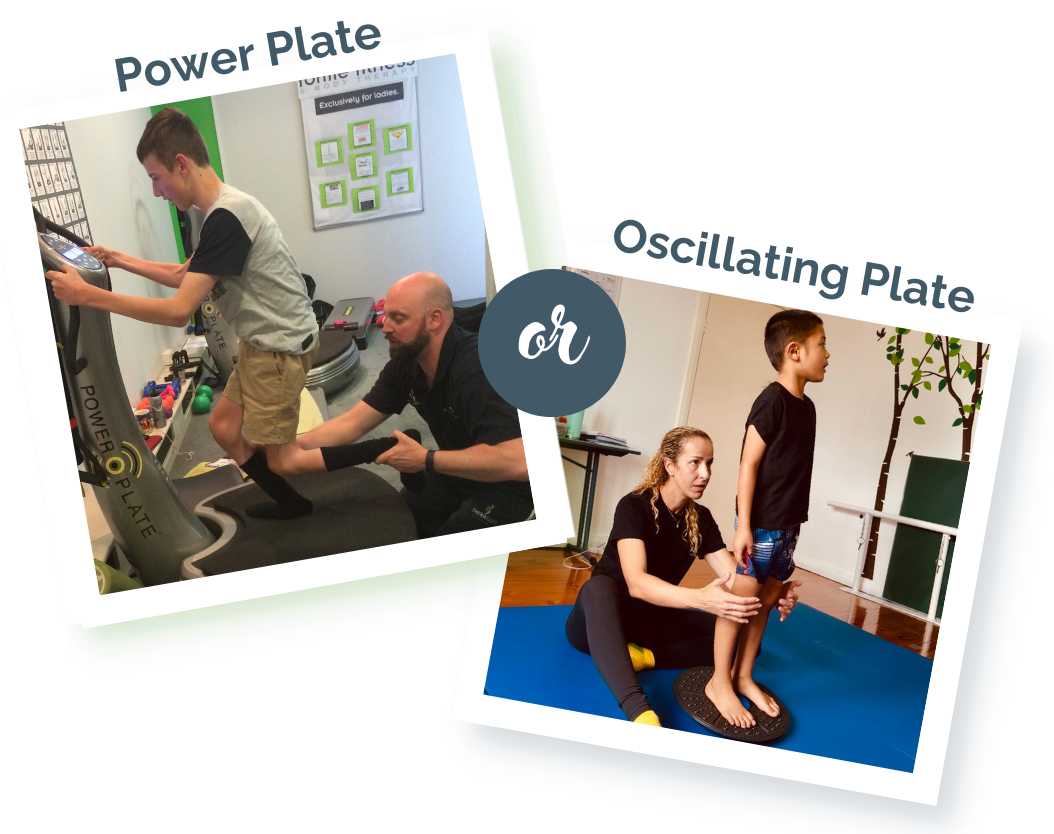
Power Plate works using tri-planar vibration, which basically means it moves in multiple directions at the same time. In simple terms, the surface feels stable, but there is still movement happening underneath you.
For children, this works really well because it allows more movement-based activities. It feels more engaging, almost like play, while still working on strength and balance.
For teens, it can support more structured exercises. Things like strength work, coordination, and even sport-related rehab.
For adults, it becomes very functional. You can do squats, weight shifts, balance work, things that actually carry over into everyday life.
Oscillating plates move differently. They shift side to side, like a see-saw, going left to right. This creates a constant weight shift from one side of the body to the other.
Because of that, they tend to suit more controlled or static positions rather than active movement.
For children, they can be useful for gentle movement and getting used to shifting weight.
For teens, they may help with basic balance awareness or short periods of muscle relaxation.
For adults, they are often used at a lower intensity. Sometimes to ease stiffness or to slowly reintroduce movement.
How Do You Decide Which Is Which?
This is where many parents feel unsure, and the answer is that it depends on your or your child’s goals.
Rather than asking “Which machine is better?”, a more helpful question is: “What do we want this therapy session to achieve?”
- Movement vs Stillness
Power Plate allows active participation, where individuals move, adjust, and engage throughout the exercise.
Oscillating plates often encourage holding positions, with movement happening to the body rather than through the body.
- Muscle Activation
Power Plate works several muscle groups at the same time, which makes it really useful for building strength, improving stability, and supporting everyday movement.
Oscillating plates work by shifting activation from one side to the other, which can help with coordination, balance awareness, and lighter muscle engagement.
- Flexibility Within Sessions
In intensive therapy, being able to adapt to the session matters a lot.
Power Plate makes it easier to move from one exercise to the next without breaking the flow of the session.
That becomes especially important when working on things like:
- Keeping children engaged
- Challenging teenagers progressively
- Supporting adults through functional tasks
How This Fits Into an Intensive Therapy Program
In real sessions, vibration therapy is just one part of the bigger picture.
At The Timmermans Method, for example, we build sessions around things like:
- Repetition of meaningful movements
- Progressive challenges
- Functional goals such as standing, walking, or transferring
- Family involvement throughout the process
Vibration platforms are used strategically to make it suitable across a wide range of needs, from children developing early movement skills to adults rebuilding strength after injury.
What This Looks Like for Different Age Groups
Children
With children, therapy needs to feel engaging. If it feels like hard work straight away, they switch off. Using something like Power Plate lets us bring in movement, a bit of play, and strength work all together, so they stay interested and actually want to take part.
Teens
Teens are a bit different. A lot of them are dealing with confidence around how they move, trying to get back into school or sport, or managing something ongoing. At this stage, they usually need a bit more structure. Strength and conditioning becomes more important, and vibration therapy can help support that without making sessions feel too heavy.
Adults
For adults, it is often about staying independent or getting back to it. That might be after an injury, a stroke, or a neurological condition. The focus tends to be more practical. We use vibration therapy in ways that carry over into daily life, things like standing, walking, or moving from one position to another.
The Role of Families and Home Practice
One thing that’s really important to understand is that therapy doesn’t stop once you leave the clinic.
A lot of the progress actually comes from what happens in between sessions. That’s where families play a big role, especially when it comes to helping children build on what they’ve already learned.
For those who want to extend their therapy beyond the clinic, we offer the option to rent a Power Plate for home use.
This can help you:
- Keep exercises going at home
- Stay consistent between sessions
- Feel more confident managing routines on your own
We also guide you through how to use it properly, so it fits into your day without feeling like extra pressure. The idea is to make it manageable, not overwhelming.
Final Thoughts
Whether you are supporting your child, helping a teenager find their confidence again, or working through your own rehab, the right approach can really change what feels possible.
Understanding the difference between tools like Power Plate and oscillating platforms is a good place to start. It helps you make decisions with a bit more clarity.
However, the equipment is only one part of it. What really makes the difference is how the therapy is delivered. The consistency, the structure, and how much meaningful work is actually happening in each session.
If you are not sure where to start, just reach out. We are always happy to have a conversation and see what might suit your situation.
You can also come and meet us in person at the Source Kids Disability Expo in Melbourne from 17–18 April 2026. We will be at booth D23, feel free to stop by, share your experience, or just ask questions.
And if you are thinking about continuing therapy at home, you can also ask us about Power Plate rental. It is a simple way to keep things going between sessions without losing momentum.