
Some beliefs are so common that they go unquestioned. One of the most influential in rehabilitation is the idea that improvement has an expiry date. That after a certain age, or a certain amount of time since injury, the best outcomes are already behind you. No one ever says therapy has an expiry date. But many families feel it.
This belief shapes goals, funding decisions, and personal motivation. It influences how much effort people are encouraged to invest and how much change they believe is possible.
As clinicians, we see the cost of this belief every day. Not because people are incapable, but because they are not given the opportunity to challenge it.
The Thought Many People Carry Quietly
Parents of teenagers often reach a point where they start asking different questions. Their child has worked hard for years. They have attended sessions, practised at home, rearranged life around therapy. Somewhere along the way, progress slowed. Conversations shifted. Instead of asking “what’s next?”, the focus moved to “let’s keep things steady”.
Adults often arrive with a similar story, even if it sounds different on the surface. Perhaps there was a stroke, a concussion, an injury, or surgery. Early rehabilitation helped. Life moved on. But something still feels off. Balance is unreliable. Movement feels inefficient. Confidence never fully returned.
Internally, the same question keeps surfacing.
“Is this really as good as it gets?”
What Neuroplasticity Really Demands
Neuroplasticity is not passive. The brain changes when it is asked to. It learns through repeated, purposeful challenges delivered close together in time. When therapy lacks intensity, progress slows. Not because capacity is gone, but because the stimulus is too weak to drive change.
In fact, teens’ and adults’ older nervous systems often require more structure and more intensity. The brain needs a clear signal that adaptation is required. That signal comes through repetition, challenge, and relevance.
When therapy provides this, the brain responds. We have seen this across ages and conditions. Not because people defy biology, but because they finally work with it.
Movement Is A Lifelong Skill, Not A Childhood Achievement
Bodies change as we grow older. Strength fluctuates. Recovery can take longer. Life becomes more complex.
What does not disappear is the brain’s ability to adapt; thus, therapy should also reflect this reality.
Neuroplasticity is sometimes spoken about as though it belongs only to infancy or early childhood. In reality, it is a lifelong process. The brain continuously reorganises itself in response to what it is asked to do.
This means learning to move differently, more efficiently, or more confidently is still possible well into adolescence and adulthood. The deciding factor is not age. It is whether the brain is given a reason, and the opportunity, to change.
Teenagers navigating growth spurts need different support than toddlers learning to walk. Adults recovering from stroke or concussion need different input than children building foundational skills.
When therapy respects this, improvement becomes possible again.
Movement And Mobility Are Not The Same Thing
Another reason progress can stall in teens and adults is that therapy becomes overly focused on mobility alone.
Mobility is about getting from point A to point B. Walking, transferring, moving through environments.
Movement includes everything that supports that mobility. Postural control. Weight shifting. Coordination. Balance reactions. Endurance. Confidence.
When movement foundations are not addressed, mobility gains can plateau. Someone may technically be able to walk, but avoid uneven ground, tire quickly, or feel unsafe in busy environments. By revisiting movement quality, even later in life, we often see improvements that ripple through daily life.
The Importance of Families, Carers, and Support Coordinators
Progress rarely happens in isolation.
Families, carers, and support coordinators play a critical role in shaping expectations and supporting carryover. When everyone understands why therapy is delivered intensively, effort becomes purposeful rather than draining.
This shared understanding helps translate gains made in the clinic into everyday life. It also supports realistic planning around time, energy, and ongoing support.
An Invitation To Rethink What Comes Next
If you are supporting a teenager or an adult and feel that expectations have quietly narrowed over time, we encourage you to revisit what might still be possible.
This conversation matters for teens and adults who:
- Require physical therapy following acquired brain injury such as stroke or encephalitis
- Are recovering from orthopaedic injury or surgery and feel they never fully returned to how they moved before
- Live with long-term neurological conditions and have been told therapy is now about maintenance
- Experience balance and coordination difficulties related to concussion, vertigo, or whiplash
As we said, movement and function can improve when therapy provides the right conditions.
If you believe that this resonates, send us a message. Share your story.
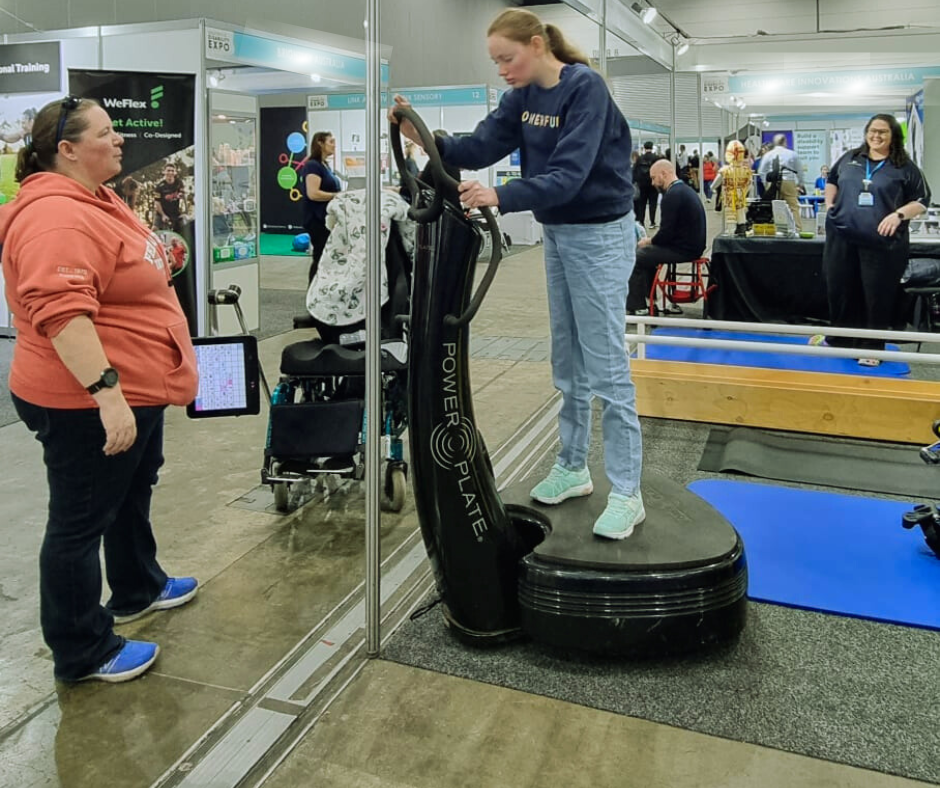
Or, alternatively, come and meet us at the Source Kids Disability Expo in Adelaide – tickets are free! We’ll be there, ready to listen.